
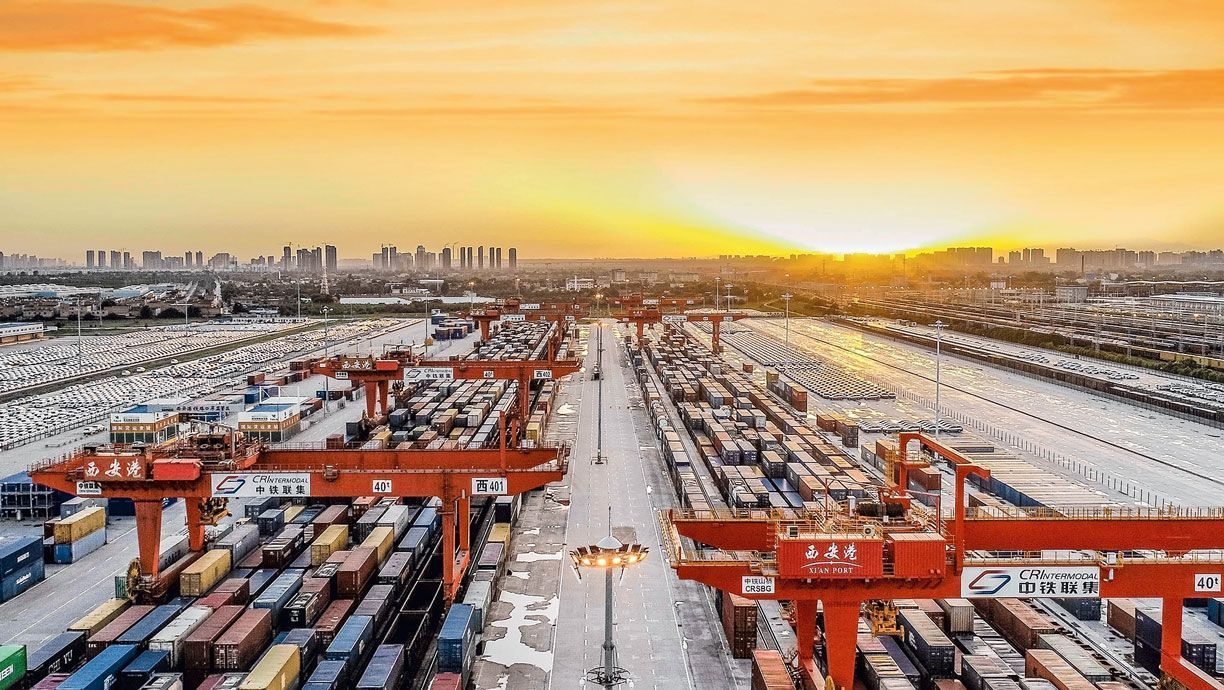
Russia, with its unique transit potential and well-developed railway infrastructure, plays a key role in this process.
The Numbers Speak for Themselves
The statistics confirm that the pivot to the East and South is no longer merely declarative. In 2025, Russian Railways’ traffic with BRICS countries totaled 305 million tons, accounting for 57% of the holding’s total international freight traffic. Performance in the first half of 2026 was even more impressive, with growth of 8.4% to 163 million tons (the pace held through nine months, with about 244 million tons carried).
China, the UAE, Brazil, India and Egypt act as the geographic locomotives, together accounting for over 98% of all traffic with the BRICS group. The main cargo categories are coal, oil cargo, chemical and mineral fertilizers, ore, grain, timber and chemicals, as well as general cargo.
Container traffic deserves special mention: between 2020 and 2025 it grew by 37% to 3.4 million TEU. Chemicals, automobiles and components, paper, fertilizers, grain and non-ferrous metals are becoming the drivers of this segment.
Six Routes as a New Arterial System
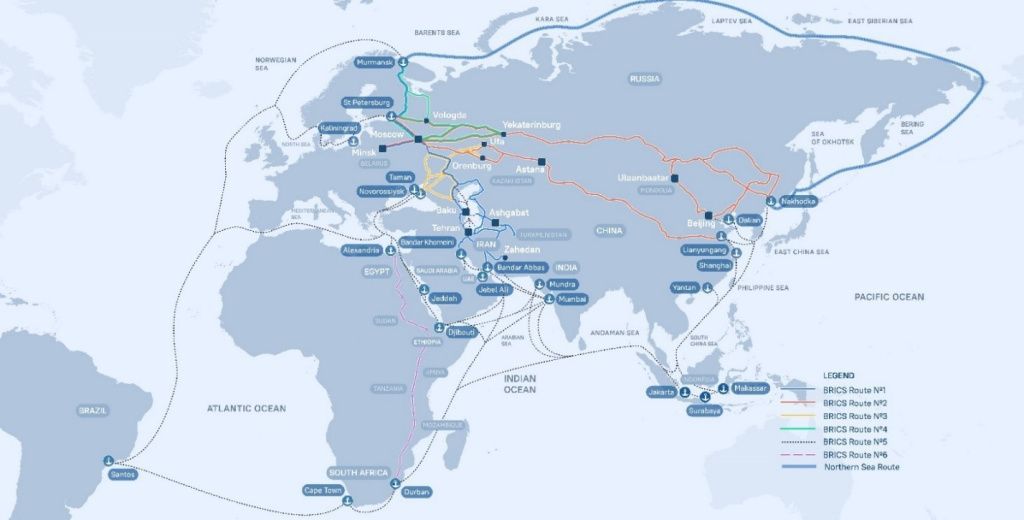
The Infrastructure, Transport and Logistics Working Group of the BRICS Business Council (which brings together 200 company representatives from the member countries) has proposed a typology of six key BRICS routes (Fig. 1):
No. 1 includes the North–South International Transport Corridor (ITC) and links Russia and Belarus with the South Caucasus, Iran, South Asia and the Persian Gulf countries.
No. 2: the East–West corridor (Russia, Belarus, Kazakhstan, Mongolia, China);
No. 3: the Azov–Black Sea route, via the ports of the Azov–Black Sea basin and then by sea to Egypt, Latin America and Africa;
No. 4: the Northwestern route (Murmansk, St. Petersburg, Arkhangelsk, Kaliningrad and then by sea to China, India, the UAE, Saudi Arabia and Brazil, including via the Northern Sea Route, or NSR);
No. 5: international shipping lines (China–Southeast Asia–India–South Africa–Brazil; Russia–Egypt–Saudi Arabia–South Africa; Russia–Egypt–Brazil);
No. 6: Trans-African routes, a prospective network of about 10,300 km (of which 8,000 km are existing lines) via Egypt, Ethiopia and South Africa.
BRICS Logistics Connectivity Index
To comprehensively assess the performance of BRICS routes, in 2026 the Working Group, together with the Coordinating Council on Trans-Eurasian Transportation, developed a composite BRICS Logistics Connectivity Index (BLCI).
The methodology, proposed by the Russian side, makes it possible to track bottlenecks and the progress of improvements.
Trial container shipments have already been made on four routes (to South Africa, China, India/UAE and Brazil) by Russian Railways, FESCO Group and PhosAgro.
Qualitative analysis shows that routes No. 2, No. 3, No. 4 and No. 5 are currently the most efficient: they are tried and tested and offer competitive delivery times.
At the same time, experts see the greatest growth potential in the North–South ITC (route No. 1) and the NSR (No. 4). Their development could fundamentally reshape the balance of logistics flows by reducing the time and cost of transportation between Asia, Europe and Africa.
A Matter of National Importance
In February 2026, by decision of Russian President Vladimir Putin, the National Committee for Business Cooperation within BRICS was established. The head of state appointed Maxim Oreshkin, Deputy Chief of Staff of the Presidential Executive Office, to chair the new body.
Oleg Belozerov, CEO and Chairman of the Executive Board of Russian Railways, has joined this coordinating body, where he oversees areas related to transport logistics, infrastructure and economic cooperation among the member countries. This underscores the importance of the transport agenda as a matter of national significance.
A key outcome of the New Delhi summit (September 2026) was the enshrinement of transport in the final Declaration as one of the main drivers of sustainable development. Similar conclusions were reflected in the Business Council’s annual report presented to the heads of state.
A Solid Foundation
Within BRICS, Russian Railways is consistently turning strategic initiatives into systemic mechanisms of multilateral cooperation—from the typology of routes and barriers and trial shipments to the development of the BRICS Transport Academy and the creation of a unified digital platform, BRICSTransport.com.
The logistics connectivity being built in this way is becoming a solid foundation for mutual trade and economic growth across BRICS countries.
 Read next content